Not All Shockwave Is the Same
If you have started researching shockwave therapy, you have probably noticed that every clinic says theirs works. What most of them do not tell you is that "shockwave therapy" is a category, not a single technology.
Different devices generate energy in fundamentally different ways. That affects how deep the energy travels, how much tissue it reaches, and which problems it suits. If you are comparing providers, the type of device matters more than the marketing on the website.
Here is a plain explanation of the three main types, and our honest reasoning for choosing the one we use.
Focused shockwave
Focused devices concentrate acoustic energy so it converges at a specific depth beneath the skin. Think of it like a magnifying glass bringing sunlight to a point. This delivers high energy to a small, precisely targeted area, and it can reach deep structures including bone.
This is the right tool when the problem is a discrete, well localized lesion and you know exactly where it is, often confirmed with imaging. It can also be quite uncomfortable and some protocols use local anesthesia.
Radial pressure wave
Radial devices generate energy at the applicator head itself, usually with a pneumatically driven projectile. That energy then radiates outward and loses intensity as it travels deeper into tissue. The strongest effect is close to the skin.
Radial devices are widely used and they are a reasonable choice for superficial conditions. Their limitation is depth: the deeper the target, the less energy actually arrives.
Unfocused shockwave
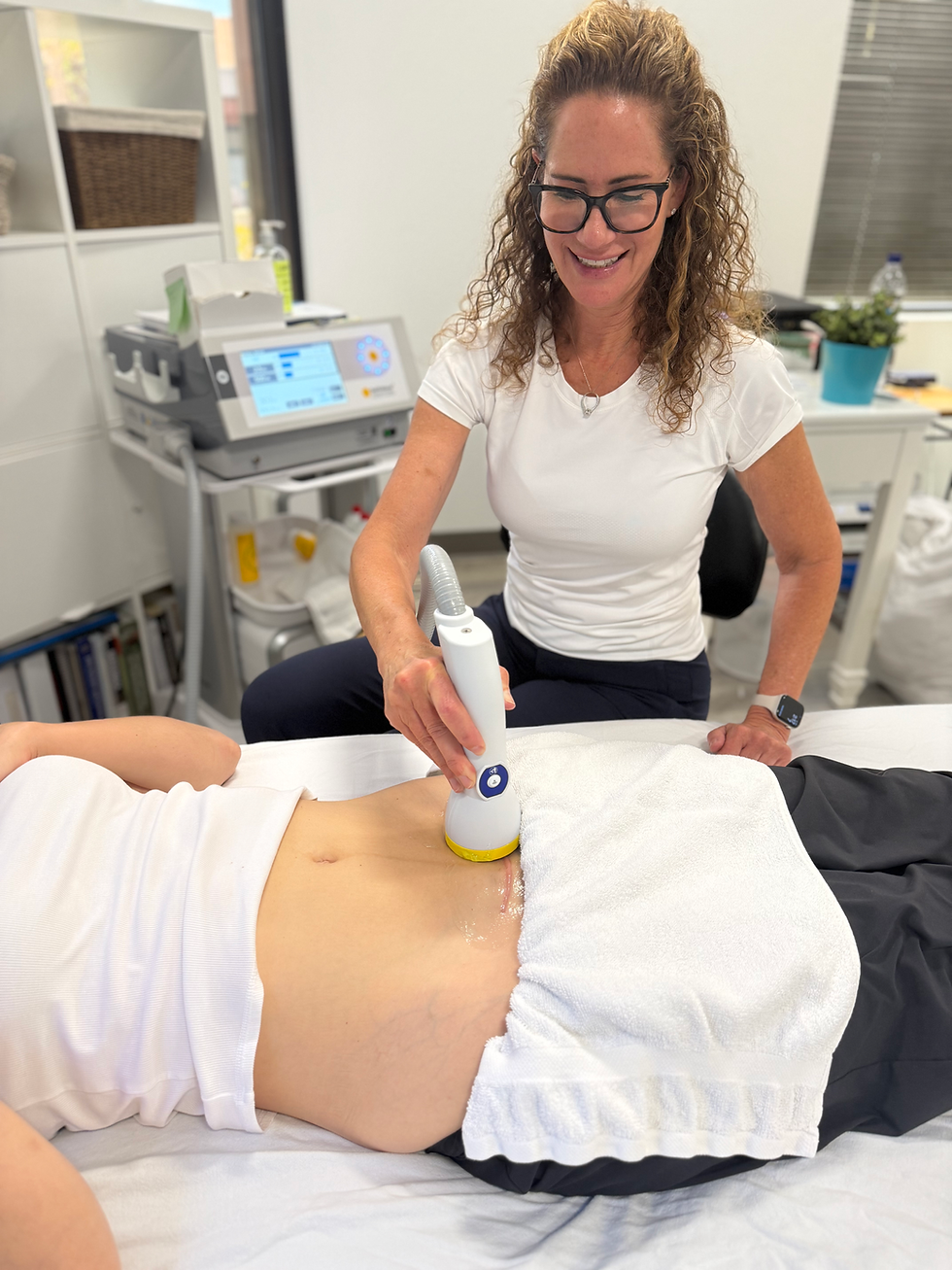
This is what SoftWave uses. Rather than converging energy at a point or concentrating it at the surface, an unfocused device spreads a true shockwave across a wider treatment zone at moderate depth.
The practical difference is coverage. Instead of treating a spot, you treat a region.
Why SoftWave
Chronic tendon and joint pain is usually not a single point of damage.
When a tendon has been painful for a year, what is happening in the tissue is typically degeneration across a region: disorganized collagen, poor blood supply, and changes that extend beyond wherever the pain feels sharpest. The boundaries of that region are often not obvious on examination, and frequently not obvious on imaging either.
That is the reasoning behind our choice. A broader treatment zone means we are less dependent on pinpointing one exact spot, and we can treat the whole affected area within a session. For plantar fasciitis, Achilles tendinopathy, and the other conditions that make up most of our practice, that suits the shape of the problem.
SoftWave is also well tolerated. Sessions run about five to ten minutes per area, and there is no downtime afterward.
We chose SoftWave because it fits the conditions we see most and the way we practice. That is a different claim than "best," and we think you should be suspicious of any clinic making the stronger one.
If you are trying to work out whether shockwave makes sense for your situation, we are happy to talk it through, including whether a different approach would serve you better.